
What’s Coming in Employment Law: How Business Leaders Can Prepare for 2026 and Beyond
The Employment Rights Act 2025 represents the biggest shake-up of UK employment law in decades. While it received Royal Assent in December 2025, the changes won’t land all at once. Instead, the Government has published a phased roadmap running through to 2027.
For small and medium-sized businesses, this creates both a challenge and an opportunity. The challenge is keeping up with the volume of change. The opportunity is to prepare early, reduce risk, and put sensible people practices in place before the pressure hits.
This post gives an overview of what’s coming, when it’s likely to happen, and how business leaders can start preparing now.
Why the Employment Rights Act matters for SMEs
Many of the changes under the Act strengthen employee rights and increase employer responsibilities. Individually, some may feel manageable. Taken together, they will:
Increase legal and financial risk if processes aren’t robust
Require better people management capability at line manager level
Reduce flexibility in areas such as dismissals, working patterns and shift work
Increase scrutiny from regulators
For growing businesses without large HR teams, this makes planning and prioritisation essential.
What’s changing first? Key employment law reforms from April 2026
The first wave of reforms is expected in or before April 2026. These are the areas most businesses should focus on now:
Statutory Sick Pay (SSP)
More employees will qualify
SSP will be payable from day one of absence
Paternity leave and ordinary parental leave
Removal of qualifying service periods
Enhanced whistleblowing protections
Trade union law reforms
Including greater union access to workplaces
Creation of the Fair Work Agency
With enforcement powers and financial penalties
Collective redundancy changes
Including a doubling of the protective award
These changes alone will affect costs, policies, and how managers handle day-to-day issues.
Looking ahead to 2027: employment law changes with long-term impact
Some of the most significant changes are planned for 2027, and these require early groundwork.
Unfair dismissal: risk much earlier in employment
- The qualifying period for unfair dismissal will reduce from two years to six months
- The compensation cap will be lifted
This means early employment decisions will carry much greater risk. Businesses will need:
- Clear probationary periods
- Consistent performance management
- Confident, well-trained line managers
Flexible working: higher expectations on employers
- Employers will need to show that any refusal of a flexible working request is reasonable
- Reasons for refusal must be clearly explained
This is likely to increase challenges where decisions are inconsistent or poorly documented.
Zero and low hours working
- Employers may need to offer guaranteed hours based on actual work patterns
- Shift workers may be entitled to compensation for cancelled or changed shifts
For businesses relying on flexibility, this could require a rethink of workforce models.
How to prepare for employment law changes: practical steps business leaders can take now
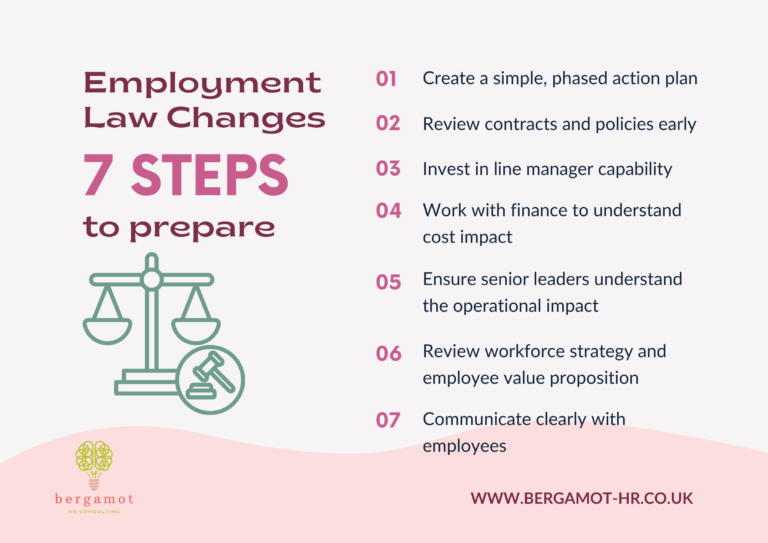
Create a simple, phased action plan
You don’t need to do everything at once. Align your HR activity with the Government’s rollout timetable and focus first on changes landing in 2026.
Ask:
Which policies will need updating first?
Which changes will affect costs or operations most?
Where do we need decisions from senior leaders?
Review contracts and policies early
Even before final regulations are published, it’s sensible to audit:
Sickness absence policies
Probation and performance management processes
Flexible working policies
Disciplinary and dismissal procedures
Early review reduces the risk of rushed changes later.
Invest in line manager capability
Many of the new requirements will be enforced in day-to-day management, not just in HR.
Now is the time to strengthen manager confidence in:
Managing probation and early performance issues
Handling flexible working requests fairly and consistently
Managing sickness absence effectively
Preventing and responding to bullying and harassment
Well-trained managers are one of the strongest risk-reduction tools available.
Work with finance to understand cost impact
Some changes will directly affect payroll and budgeting, including:
Increased SSP costs from day one of absence
Greater exposure to employment tribunal claims
Penalties linked to enforcement by the Fair Work Agency
Potential costs linked to shift work and guaranteed hours
Understanding the numbers early helps avoid unpleasant surprises.
Ensure senior leaders understand the operational impact
The Act will affect strategic business decisions, including:
Restructures and redundancies
Changes to terms and conditions
Use of casual, zero hours or shift-based labour
Engagement with trade unions
Senior leaders need to understand what may no longer be possible and what alternative approaches exist.
Review workforce strategy and employee value proposition
As employee rights expand, businesses may want to reconsider:
How attractive their sick pay and flexibility offerings really are
Whether current working patterns remain fit for purpose
How they want to position themselves as an employer
Handled well, compliance can support attraction, retention and engagement.
Communicate clearly with employees
Employees will hear about these changes in the media — not always accurately.
Clear, calm communication can:
Reduce anxiety
Manage expectations
Reinforce trust and transparency
This might start with a simple message explaining that changes are coming gradually and that the business will keep people informed as details are confirmed.
Final thoughts: preparation beats reaction
The Employment Rights Act 2025 is not something to “wait and see” on. For SMEs in particular, early planning, practical prioritisation and strong manager capability will make the difference between controlled change and costly disruption.
If you’d like support reviewing your risks, updating policies, training managers or building a clear roadmap tailored to your business, this is exactly where Bergamot HR can help.
Getting ahead of employment law changes now will put you in a far stronger position for 2026 — and beyond.